Startup booted is the name this guide uses for a revenue-first way of building a company: prove the business works on customer revenue, keep control of your equity, and raise outside money only for a specific reason and on your terms. This article explains the approach, then walks through a startup booted fundraising strategy and a startup booted financial modeling method, with worked examples you can adapt.
Last updated October 2026. “Startup booted” is not a formal industry term. It is our label for a capital-efficient, bootstrapped-first approach, and it is closely related to bootstrapping and lean startup practices. Examples use illustrative numbers, not real company data. This is general education, not financial, tax or legal advice.
Key takeaways
- Startup booted means proving the business on revenue first, then raising selectively, if at all.
- A good fundraising strategy starts with your numbers: runway, growth, churn and unit economics decide how much leverage you have.
- A 12-month financial model shows which assumption your survival depends on. Update it monthly with real data.
- Raising money is a tool, not a goal. Each round trades ownership for speed, so know what the money will buy before you ask.
- What startup booted means
- Startup booted vs bootstrapping vs venture capital
- Four principles
- Startup booted fundraising strategy
- Startup booted financial modeling
- Cash flow and runway management
- Unit economics: CAC, LTV and payback
- Real companies that grew with little outside capital
- Common mistakes
- FAQ
What startup booted means
A startup booted company treats customer revenue as its main source of funding. The founders build a paid product early, watch cash carefully, and keep outside investment as an option, not a requirement. Four ideas define it: revenue first, founder control, selective capital and financial discipline.
Because the phrase is not a standard industry term, here is what it is and is not. It is a practical label for bootstrapping with a clear plan for if and when to raise money. It is not a legal structure, a funding product or a guarantee of success. You may also see websites with similar names in search results. This guide is independent and not affiliated with any of them. In founder slang, being “booted” can also mean being removed from an accelerator, marketplace or investor relationship, which is a different topic.
Startup booted vs bootstrapping vs venture capital
| Factor | Startup booted | Pure bootstrapping | Venture-backed |
|---|---|---|---|
| Funding source | Revenue first, selective capital later | Savings and revenue only | Investor equity, repeated rounds |
| Ownership | Founders keep most equity | Founders keep all equity | Founders are diluted each round |
| Growth speed | Steady, funded by cash flow | Limited by cash flow | Fast, funded by investor cash |
| Pressure | Profitability and runway | Cash survival | Growth targets and a large exit |
| Best for | Software and service businesses with fast paying customers | Side projects and very small teams | Winner-take-most markets needing heavy upfront spend |
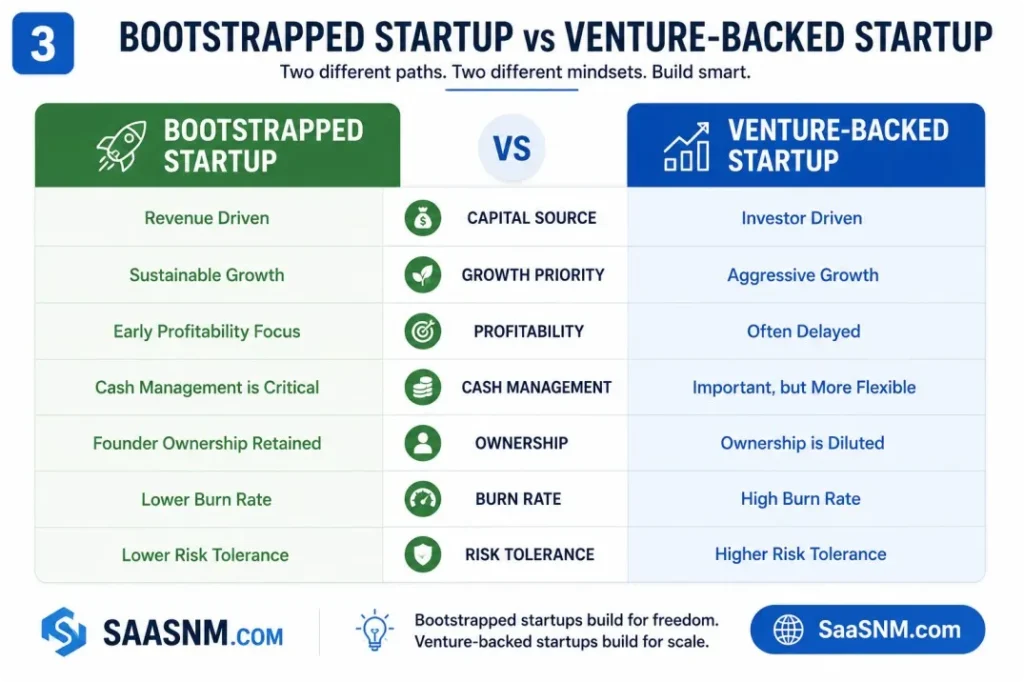
For a broader look at funding yourself, read our bootstrapped startup guide.
Four principles
1. Revenue first
Charge early. A few paying customers prove more than hundreds of free sign-ups, and their revenue funds the next step of development.
2. Founder control
Every equity round gives up ownership and some decision rights. Keeping control lets you choose your pace, your market and your exit.
3. Selective capital
Startup booted does not mean refusing all investment. It means raising when you can name what the money will buy, such as a sales hire for a channel that already converts.
4. Financial discipline
Track revenue, costs, cash and runway every month. Discipline is what makes selective fundraising possible, because you negotiate from data.
Startup booted fundraising strategy: when and how to raise
A startup booted fundraising strategy begins before you meet an investor. It answers four questions: do you need outside capital, how much, in what form, and what will it change?
Signals you may be ready to raise
- Revenue is growing predictably for several months, not just in one spike.
- Churn is stable or falling, so new customers are not just replacing lost ones.
- You have a channel that works and more money would clearly scale it.
- Your runway is long enough to negotiate without pressure, ideally 9 to 12 months or more.
Funding options compared
| Option | How it works | Main trade-off |
|---|---|---|
| Self-funding | Savings, family and friends, retirement funds, as the SBA funding guide describes | You keep control but carry all the risk |
| SAFE | A contract giving an investor the right to shares in a later priced round, per Y Combinator | Simple and fast, but the valuation cap sets future dilution |
| Convertible note | Debt that converts to equity later | Adds interest and a maturity date |
| Priced equity round | Investors buy shares at a set valuation | Board seats and more complex terms |
| Bank or SBA-backed loan | Repayable debt, which requires a plan and projections, per the SBA | No equity loss, but fixed repayments |
| Grants | Competitive programs such as SBIR and STTR for eligible research-driven companies | Time-consuming and limited eligibility |
Dilution example (illustrative)
Assume founders own 100 percent. They raise $500,000 on a SAFE with a $5 million post-money cap, so the investor receives about 10 percent when it converts. Later they raise $3 million in a priced round at a $15 million post-money valuation, which sells 20 percent. After both rounds, founders own roughly 72 percent (100 percent × 0.90 × 0.80), before counting any employee option pool. These are illustrative numbers. Real deals vary, and a lawyer should review any investment document.
Metrics investors usually ask about
| Metric | What it tells an investor |
|---|---|
| Monthly recurring revenue (MRR) and growth rate | Whether demand is real and accelerating |
| Churn rate | Whether customers stay, which drives lifetime value |
| CAC and payback period | How efficiently you turn spending into customers |
| Gross margin | How much of each sale is left to fund the business |
| Burn rate and runway | How long you can operate before running out of cash |
| Customer concentration | Whether a few large customers carry the revenue |
Having these figures ready, updated monthly, is the clearest sign of financial discipline. It also helps you decide whether you need to raise at all.
How to prepare
- Know your numbers cold: monthly recurring revenue, growth rate, churn, customer acquisition cost and runway.
- Build a base, slow and fast scenario so you can show how the plan behaves under stress.
- Set a target raise tied to specific milestones, not a round number.
- Keep a clean list of customers, contracts and metrics ready for due diligence.
- Have a plan B. If the round does not close, which costs do you cut?
Fundraising is outside the scope of this guide as legal advice. Consult a startup lawyer before signing a SAFE, note or term sheet.
Startup booted financial modeling: build your 12-month model
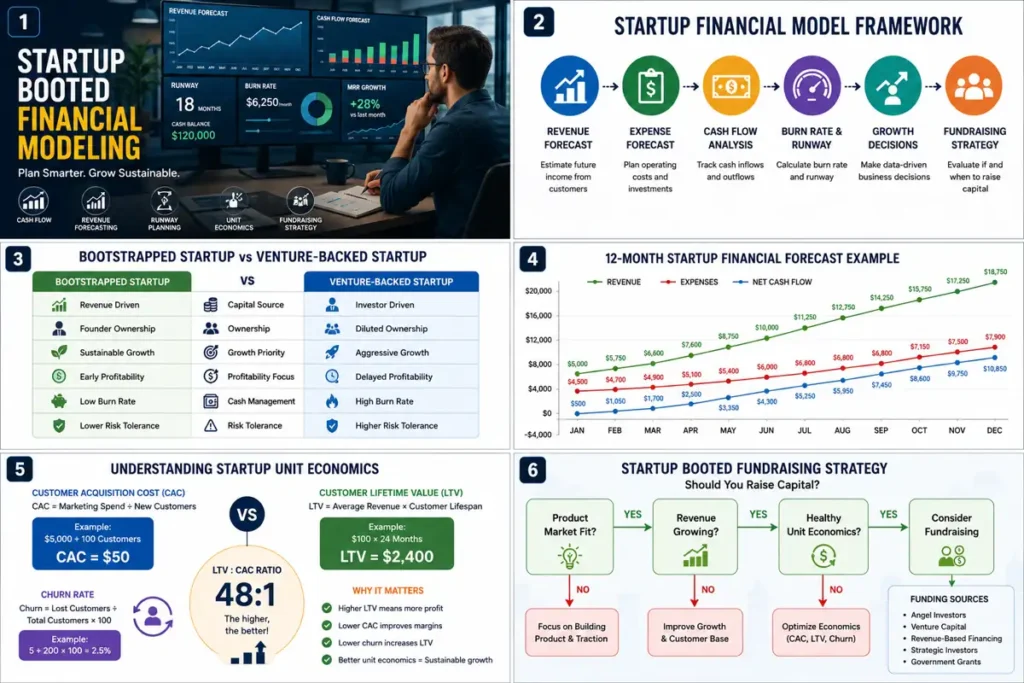
Startup booted financial modeling is simply forecasting your revenue, costs and cash so you can see how long you can last and what must go right. You do not need an elaborate spreadsheet. A simple monthly model with clear assumptions beats a complicated one nobody updates. The SCORE financial projections template is a free starting point.
The three statements in plain terms
- Profit and loss: revenue minus costs over a period.
- Cash flow: the actual money moving in and out, which is what keeps you alive.
- Balance sheet: what you own and owe at a point in time.
Assumptions for the example
This illustrative software business charges $49 a month per customer. It starts with $40,000 in cash, has $4,500 a month in fixed costs (tools, a contractor, marketing and other expenses) plus variable costs of 15 percent of revenue. It signs no customers in month 1, then 6, 8, 10 and so on, rising to 26 new customers in month 12, and loses 4 percent of existing customers each month. These numbers are made up for teaching purposes.
| Month | New customers | Customers | Revenue | Costs | Net | Cash at month end |
|---|---|---|---|---|---|---|
| 1 | 0 | 0 | $0 | $4,500 | -$4,500 | $35,500 |
| 2 | 6 | 6 | $294 | $4,544 | -$4,250 | $31,250 |
| 3 | 8 | 14 | $686 | $4,603 | -$3,917 | $27,333 |
| 4 | 10 | 23 | $1,127 | $4,669 | -$3,542 | $23,791 |
| 5 | 12 | 34 | $1,666 | $4,750 | -$3,084 | $20,707 |
| 6 | 14 | 47 | $2,303 | $4,845 | -$2,542 | $18,165 |
| 7 | 16 | 61 | $2,989 | $4,948 | -$1,959 | $16,205 |
| 8 | 18 | 77 | $3,773 | $5,066 | -$1,293 | $14,912 |
| 9 | 20 | 94 | $4,606 | $5,191 | -$585 | $14,327 |
| 10 | 22 | 112 | $5,488 | $5,323 | $165 | $14,492 |
| 11 | 24 | 132 | $6,468 | $5,470 | $998 | $15,490 |
| 12 | 26 | 153 | $7,497 | $5,625 | $1,872 | $17,362 |

In the base case, monthly cash flow turns positive in month 10, cash never falls below $14,327, and the business ends the year with $17,362. Now stress it:
| Scenario | New customers vs base | Lowest cash | Cash-flow positive from | Cash after 12 months |
|---|---|---|---|---|
| Slow | 50 percent of base | $1,785 | not within 12 months | $1,785 |
| Base | As above | $14,327 | month 10 | $17,362 |
| Fast | 130 percent of base | $18,244 | month 9 | $26,775 |
The slow case shows the real risk: with half the new customers, cash falls to about $1,785 by month 12 and monthly cash flow never turns positive, which leaves almost no runway. That tells a founder to cut costs sooner, extend the timeline, or raise a small amount on better terms. Update the model every month with actual numbers.
Cash flow and runway management
Runway is your cash divided by your monthly net burn. If you have $30,000 and lose $3,000 a month, you have about ten months. Revenue growth changes that picture over time, which is why a model beats a single number.
- Track cash weekly, not only monthly, when runway is short.
- Invoice promptly and offer annual plans. Upfront annual payments improve cash without outside funding.
- Separate fixed and variable costs. Fixed costs shrink runway even in slow months.
- Set trigger points. Decide in advance what you will cut if runway drops below six months.
- Build a buffer. A reserve covering a few months of fixed costs protects against late payments and churn spikes.
The SBA funding guide is useful if you are weighing loans against equity, since it explains what lenders usually ask for, including projections.
Unit economics: CAC, LTV and payback
Unit economics show whether each customer is worth what it costs to win them. Three numbers matter most: customer acquisition cost (CAC), lifetime value (LTV) and payback time.
- CAC: total sales and marketing spend divided by new customers won.
- LTV: average revenue per customer × gross margin ÷ monthly churn rate.
- Payback: CAC ÷ monthly gross profit per customer.
Using the example above: $49 a month × 85 percent gross margin ÷ 4 percent churn gives an LTV of about $1,041. If CAC is $150, the LTV to CAC ratio is about 6.9 to 1, and payback takes about 3.6 months. A commonly quoted rule of thumb is an LTV to CAC ratio of at least 3 to 1, but treat that as a guide, not a rule, since it depends on your market and growth stage.
Real companies that grew with little outside capital
Mailchimp grew for two decades without venture funding and was acquired by Intuit in 2021 in a deal reported at about $12 billion. Read the coverage from Indie Hackers and Tekedia.
Zapier built its automation platform with very little outside capital. Forbes reported a valuation of around $5 billion in 2021.
Basecamp (37signals) has long run as a profitable, self-directed business. Co-founder Jason Fried has spoken about two decades of bootstrapping Basecamp.
GitHub shows a middle path. It was built for years without outside funding before taking a $100 million investment from Andreessen Horowitz in 2012. These companies are exceptions in one sense, since most startups fail whatever funding path they choose.
Common mistakes
- Raising before you have proof. Early money without traction usually means worse terms.
- Modeling only the best case. Always include a slow scenario.
- Ignoring churn. Growth that leaks is expensive growth.
- Mixing up profit and cash. Customers who pay late can sink a profitable business.
- Treating bootstrapping as a badge. If outside capital clearly wins a market, refusing it on principle can cost more than the dilution.
- Never updating the model. A forecast is only useful when compared with reality each month.
Frequently asked questions
What does startup booted mean?
Startup booted is a label for a revenue-first, bootstrapped-first approach: prove the business on customer revenue, keep founder control and raise outside capital selectively. It is not a formal industry term.
What is a startup booted fundraising strategy?
It is a plan for raising money from a position of strength: know your runway and unit economics, raise only for specific milestones, choose the right instrument such as a SAFE or priced round, and understand the dilution before you sign.
What is startup booted financial modeling?
It is building a simple monthly forecast of revenue, costs and cash, with base, slow and fast scenarios, so you can see your runway and which assumptions matter most.
Is startup booted the same as bootstrapping?
They overlap. Bootstrapping means funding the business from savings and revenue. Startup booted adds a deliberate plan for when and how to raise outside money if it makes sense.
Can a startup booted company still raise venture capital?
Yes. Many founders prove demand first, then raise on better terms. Revenue, retention and clear unit economics are strong leverage.
How much runway should a startup have before raising?
There is no fixed rule. Many founders aim for roughly 9 to 12 months or more so they can negotiate without pressure, but the right number depends on your market and burn rate.
What is a good LTV to CAC ratio?
A commonly cited rule of thumb is 3 to 1 or higher, but it depends on your business model, churn and growth stage. Use it as a guide, not a rule.
Do I need a lawyer to raise money?
Usually yes. A startup lawyer can review a SAFE, convertible note or term sheet. This article is general information, not legal advice.
Related reading: our growth navigate startup tools guide covers the software stack, and free SaaS tools for startups lists more options.
About the author. John Div is a SaaS and AI writer and developer who covers AI-powered productivity tools, presentation software and SaaS platforms. He combines hands-on development experience with practical testing of emerging tools to help startups and businesses choose the right software. Questions or corrections? Contact us.
How this guide was made: it draws on public reporting and standard startup finance practice, with sources linked in the text. The models use illustrative numbers calculated for teaching, not real company data. This is general education, not financial, tax or legal advice. Last reviewed October 2026.